Olympia
Author: Carmen Ramírez Cañas
Institutional affiliation: University of Seville (Spain)
Contact: carmenramirez2297@gmail.com
Date: 01/06/2021
DOI: https://dx.doi.org/10.12795/2022.grepure_project.notice_12
Modern site name: Olympia
Ancient site name: Ολυμπία
Location: Olympia, Elis, Greece
GPS Coordinates: DD 37.63794953426429 – 21.63021740776035
Site chronological span: Between the 4th millennium BC and the 5th century AD, with its peak moment between the 8th century BC- 4th century AD (Panhellenic sacred center)
I. CONTEXT DATA
- Name: Sanctuary of Zeus (Ancient city of Olimpia)
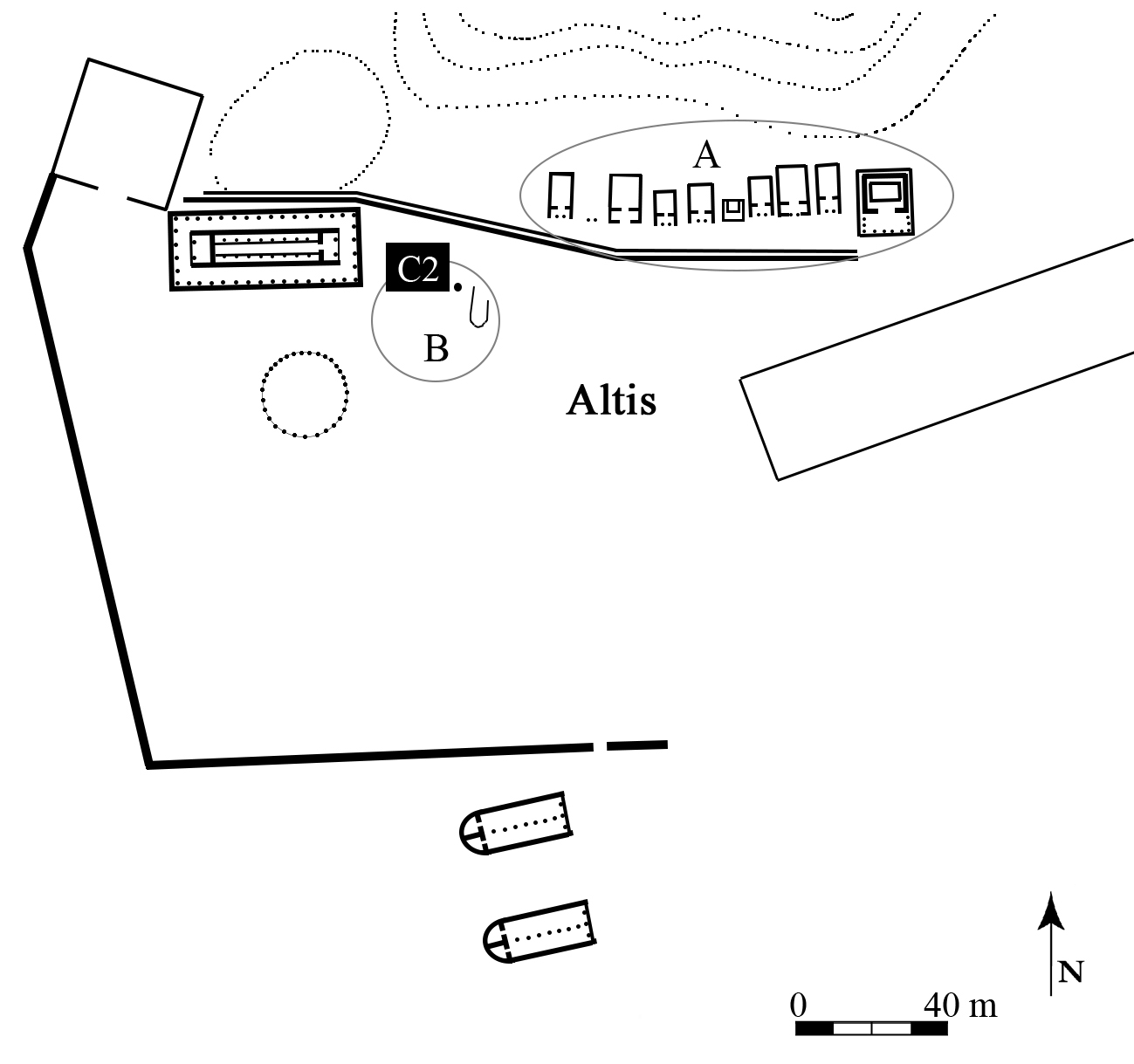
- Date of discovery/excavation season: During the 1875-1881 field season carried out by the German Archaeological Institute.
- Chronology: 8th-7th century BC
- General description (max. 1000 word): Located in the Peloponnese, in the southwest of Kronos Hill, the earliest archaeological evidence at Olympia dates back to the 4th millennium BC. Although the initial confirmation of settlement dates back to the Bronze Age, the peak phase for this archaeological site can be placed between the 10th and 9th centuries BC, when Altis, the sacred forest, began to take shape. Although the precise date for the starting point of the cult of Zeus at Olympia is difficult to establish, terracotta and bronze votive offerings in his honor are among the earliest finds from the Geometric Period. Most of the hundreds of bronze and terracotta votive statuettes dating to the 10th-8th centuries BC were found in the black ash layer around the Pelopion area, where the ashes of the altar of Zeus were placed, probably sometime during the 7th century BC. The presence of Levantine bronze items at the Panhellenic sanctuary in Olympia is an interesting fact: even if the presence of overseas offerors is highly improbable, the use of these imports from the Phoenician coast in such a sacred place shows the importance of the Phoenician input during the Geometric era. Throughout this period, and until the Archaic period, there were no buildings in the sanctuary, except for the sacrificial altars and the tomb of Pelops. The great development of the Panhellenic sanctuary of Olympia – managed by the city-state of Elis – took place during the Archaic period, when the first monumental buildings were erected, such as the Temple of Hera, the Bouleuterion and the various thesauroi. From that moment onwards, it was the site of the Olympic Games, the first of which were held in 776 BC, according to ancient written sources. The most important phase of its enhancement took place in the Classical period when the Temple of Zeus was built. During the Hellenistic period the construction of secular buildings continued, such as the palestra and the thermal bathhouses, which were renovated in Roman times; as well as areas were athletes could reside, train and compete. They continued to be in use during the early years of Roman rule. However, the last Olympic Games were held in 393 AD, after Theodosius I banned them. The final decline of the sanctuary took place in the 5th century AD, during the rule of Theodosius II. Subsequently, small Christian settlements developed over the remaining abandoned buildings. Two episodes of strong earthquakes, in 522 and 551 AD, led to the destruction and complete abandonment of the site. The floods and sedimentary deposits of the Alpheus and Kladeos rivers eventually covered the remains of Olympia.
- References (up to three references, following APA bibliographic standards): Barringer, J. M. (2010). Zeus at Olympia. In A. Erskine and J. Bremmer (eds), The Gods of Ancient Greece: Identities and Transformations (pp. 155-177). Edinburgh, United-Kingdom: Edinburgh University Press. Mallwitz, A. & Herrmann, H. V. (1980). Die Funde aus Olympia: Ergebnisse hundertjährige Ausgrabungstätigkeit. Athens, Greece: Deutsches Archâologisches Institut. Romano, D. & Voyatzis, M. (2021). Sanctuaries of Zeus: Mt. Lykaion and Olympia in the Early Iron Age. Hesperia, 90(1): 1-25. DOI: 10.2972/hesperia.90.1.0001.
II. ITEM DATA
- Item or set ID: Item C1: National Archaeological Museum, Athens. NM 7941. Item C2: Archaeological Museum, Olympia Inv. No. 8555.
- Material: metal, bronze
- Class: bronze bowls
- Typology: C1, “Megiddo Group” (Syrian-Phoenician Group); C2, “Group of bulls A” (North-Syrian Group), see Almagro-Gorbea, 2015, p.
- Number of items: 2
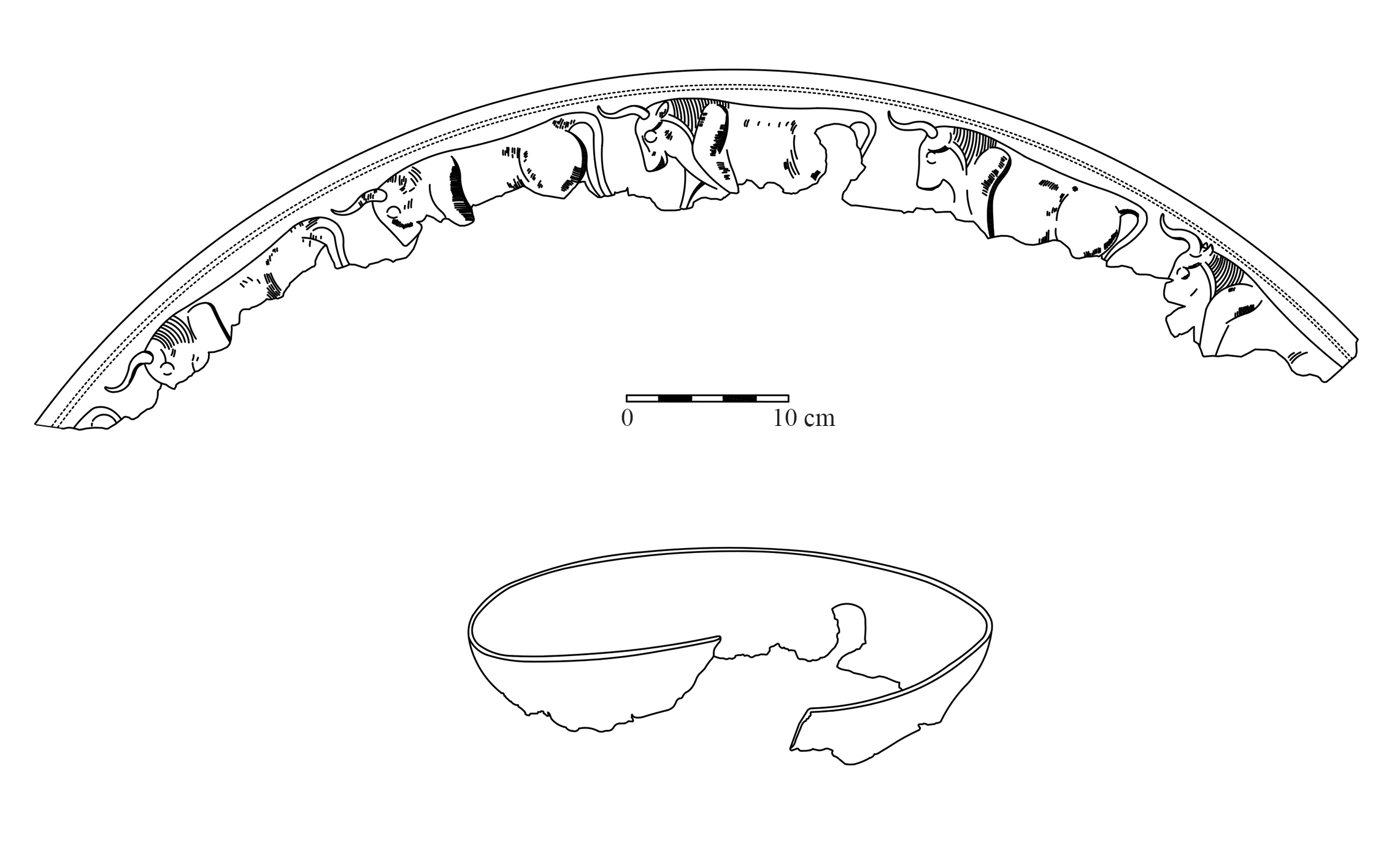
- Preservation conditions: Both bronze bowls discussed here are relatively well preserved. Object C1 is mostly intact, even if the outer surface is worn; on the other hand, bowl C2 presents an almost complete rim fragment, although most of the body and the feet are missing.
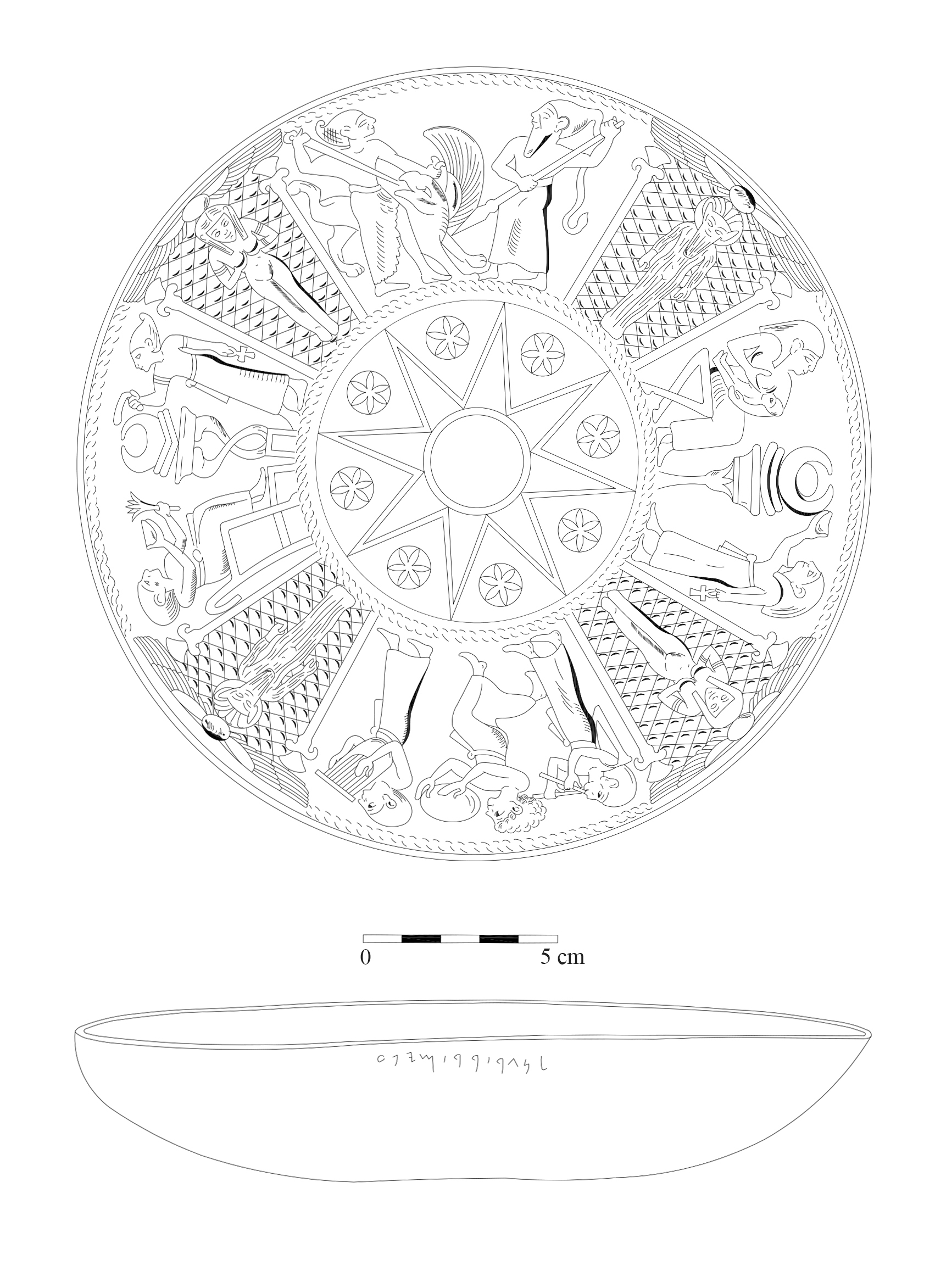
- Metrics: C1: diameter 20.4 cm; thickness 0.25 cm; height 3.5 cm; C2: diameter 16 cm; thickness 0.3 cm
- Provenance/fabric description: No archaeometric analyses have been carried out to determine the origin of these two bronze bowls. However, they share a common iconography and production techniques, and it should be considered that they both have a relatively similar provenance. The study of their origin is based mostly on typological analysis, approached from an iconographic point of view. On the one hand, item C1 has been associated with Syrian-Phoenician-style bowls, characterized by a central star motif, dated throughout the 8th century BC. As such, we should emphasize that similar examples have been identified at Megiddo (Israel). Furthermore, the existence of an Aramaic inscription on this bowl is further evidence of its Levantine provenance. On the other hand, the bronze bowl C2 was made in a style that corresponds to the one recognized among various North-Syrian workshops, corresponding with a time of wide-ranging impact of North-Syrian trade in the Aegean, between the 10th century and the first half of the 8th century BC. In addition to the two bowls mentioned above, another example of Levantine bronze bowl with similar iconography was discovered at Olympia in the southeast of the Zeus sanctuary. This bowl is marked with a Phoenician inscription -not published so far-, which provides further evidence to underline the Levantine origin of these artifacts.
- Item or dataset description: These bowls were found during the fieldwork carried out at Olympia by E. Curtius (1875-1881). In both cases, the iconographic motifs were made created using the embossing technique, with engraved outlines and details. The excavation report indicates that C1 was found at the beginning of the excavations, near the Alpheus River. At the base, it has a star-shaped medallion with small rosettes between its points. The body is formed by a quadripartite frieze divided by four aedicules, two with a naked female deity holding her breasts and two with a bearded male deity. As for the scenes represented, we distinguish: a) a cult scene with an enthroned male deity holding a bowl in his right hand and a lotus flower in his left, in front of whom stands a male figure holding an ankh in his left hand; b) two male characters using spears to kill a griffin; c) a cult scene with a seated female deity breastfeeding a child, and a female attendant in front of her a holding a bowl in her right hand and an ankh in her left hand; d) musicians playing a lyre, a tambourine and a double flute. In addition, this bowl has an Aramaic inscription on the outer side, under the rim. The item C2 was found within the enclosure of the temenos of the Zeus Olympios sanctuary, near the altar of Zeus itself. Its graphic content is characterized by the representation of five bulls with lowered heads represented in line, perhaps as part of a ceremonial or sacrificial ritual.
- Epigraphy: The bronze bowl C1 has an inscription in Aramaic. It includes 12 characters distributed in a single line, placed on the outside, under the rim: INgd/r br myf’ = le-Nagid/r bar Mêphâ’. This inscription has been translated as: Nagid, son of Mepha
- References (previous publication/s of the item or set, according to APA standards): Almagro-Gorbea, M. (2015). Los cuencos decorados fenicios o ‘phoenician bowls’. In J. Jiménez Ávila (ed.), Phoenician Bronzes in the Mediterranean. Madrid, Spain: Real Academia de Historia. Furtwängler, A., Curtius, E. & Adler, F. (1980). Olympia. Die Ergebnisse der von dem Deutschen Reich veranstelteten Ausgrabung. Tafelband IV: Die Bronzen und die übrigen kleineren Funde von Olympia. Bearbeitet von Adolf Furtwängler. Berlin, Germany: A. Asher & Co. Markoe, G. (1985). Phoenician bronze and silver bowls from Cyprus and the Mediterranean. Berkeley, CA: University of California Press.
III. ILLUSTRATIONS