Phoenician Amphorae SJ9 Kommos
Author: Max Luaces, Aroa Heredia Barroso
Institutional affiliation: University of Seville (Spain)
Latest version published: 12 of July 2021
How to cite: Luaces, M., Heredia, A. (2021): “Phoenician Amphorae SJ9 (Kommos)”.
Phoenician and Punic remains in the Aegean – GREPURE Project
[https://grepure.us.es/map/kommos/phoenician-amphorae-sj9-kommos/]
DOI: https://dx.doi.org/10.12795/2022.grepure_project.notice_09
Modern site name: Komos
Ancient site name: Κομμός (Kommos)
Location: Komos, Crete, Greece
GPS Coordinates: DD 35.01347887169699, 24.760691612750247
Site chronological span: 4th millennium BC – 2nd century BC
I. CONTEXT DATA
- Name: Kommos (Crete)
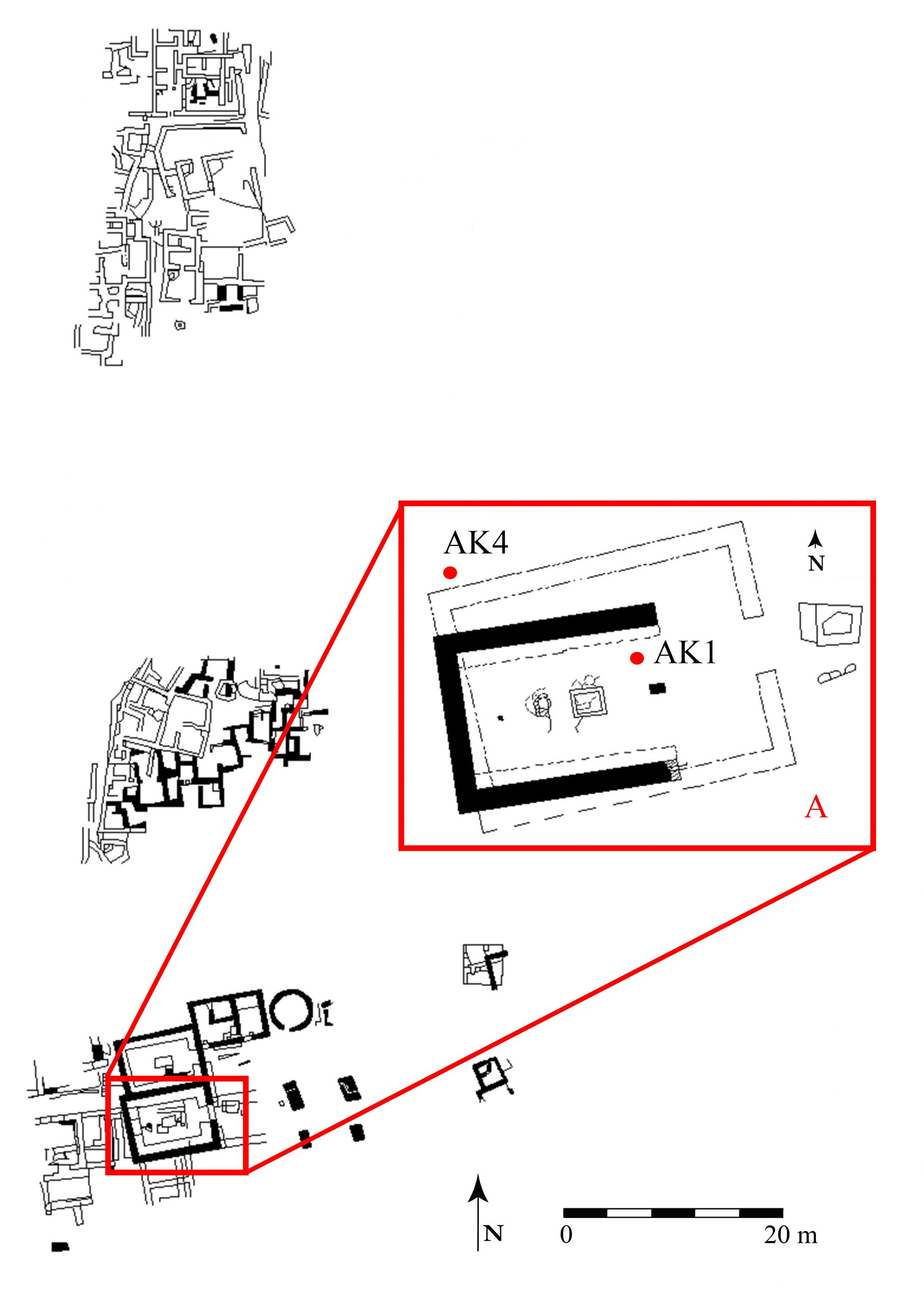
- Date of discovery/excavation season: the site was discovered at the beginning of the 20th century by Sir Arthur Evans. New excavation seasons began in 1976, which continued almost without interruption until 1994.
- Chronology: Temple B, where most of the Phoenician amphorae discussed here have been found, probably was in use between the 9th and the 7th centuries BC. The amphora type identified here shares part of this chronological span.
- General description: The archaeological site of Kommos, located in the southwest of the island of Crete, stands out above all for its strategic position on the ancient maritime trade route, mostly for its marine connection with the Levant. Although there is evidence of the existence of a Neolithic settlement slightly scattered throughout the area, and also ceramics belonging to this chronology, the time of greatest significance for the city took place during the late Bronze Age and the Iron Age. In fact, some authors have linked the site of Kommos with the well-known port of Phaistos, what is no more than a hypothesis since other researchers suggest that the location of Phaistos was actually Matala. This results of an interpretation of Homer’s Odyssey, in which the shipwreck of Menelaus after the Trojan War took place off the coast of Kommos. However, the most outstanding feature of the city are the uninterrupted contacts with the Levant, illustrated by the significant quantity of Near-Eastern and Phoenician artifacts that have been found in the site. Due to the importance of Levantine material, some researchers proposed that some Phoenician commercial facilities would have been established in the Cretan city. Leaving aside the several residential contexts dating from the Early and Middle Minoan periods, most of the structures identified in the area can be dated in the Early Iron Age. Among the most meaningful buildings in the city, we should mention the existence of series of temples that were replaced in a latter period. In particular, the layout of the so-called “Temple B” shows evidence of Phoenician influence, and, therefore, could have been related to the presence of Phoenician seafarers. The excavation of one of the last phases of this building revealed a large set of Phoenician amphorae, which also support the importance of Phoenician influence in the city of Kommos. However, no material evidence seems to support the existence of a Phoenician community during the Early Iron Age. Temple B was later on replaced by a more “Greek-style” structure during the Classic period, which was associated with several altars and presumably related to the cult of Apollo. This Temple B was replaced by another shrine (“Temple C”) during the Hellenistic era. Various “temple dumps” have been identified around these cult complexes, which provided an important set of materials, mostly pottery dated between the Protogeometric period and the Late Hellenistic era. After a short period of renewed importance during the Hellenistic period, illustrated by the construction of new civic buildings like the so-called “Temple C” and other religious structures, the city underwent a progressive decline under Roman rule. It was probably connected to its lesser economic importance at that time. It was gradually abandoned throughout the 1st century BC and it was never populated again after the change of era.
- References:
- Muñoz, J. (2017). The Role of Kommos in Phoenician Routes (White Rose College of Arts and Humanities Journal, Issue 3) Universities of Leeds, Sheffield and York.
- Shaw, J. W. (1981). Excavations at Kommos (Crete) during 1980. Hesperia, 50(3), 211-251.
- Shaw, J. W. (2006). Kommos: a Minoan harbor town and Greek sanctuary in Southern Crete. American School of Classical Studies at Athens.
II. ITEM DATA
- Item or set ID: AK1, AK2, AK3, AK4, AK5, AK6, AK7 and AK8.
- Material: Ceramic
- Class: Amphora
- Typology: Aznar type 1B, Bikai type SJ9, Pedrazzi type 5.5.
- Number of items: at least 8 different amphorae of similar type have been identified in the same context of Temple B, which are discussed in detail below; however, it is worth to note that 308 sherds of Phoenician amphorae have been accounted for among the Protogeometric context of Kommos.
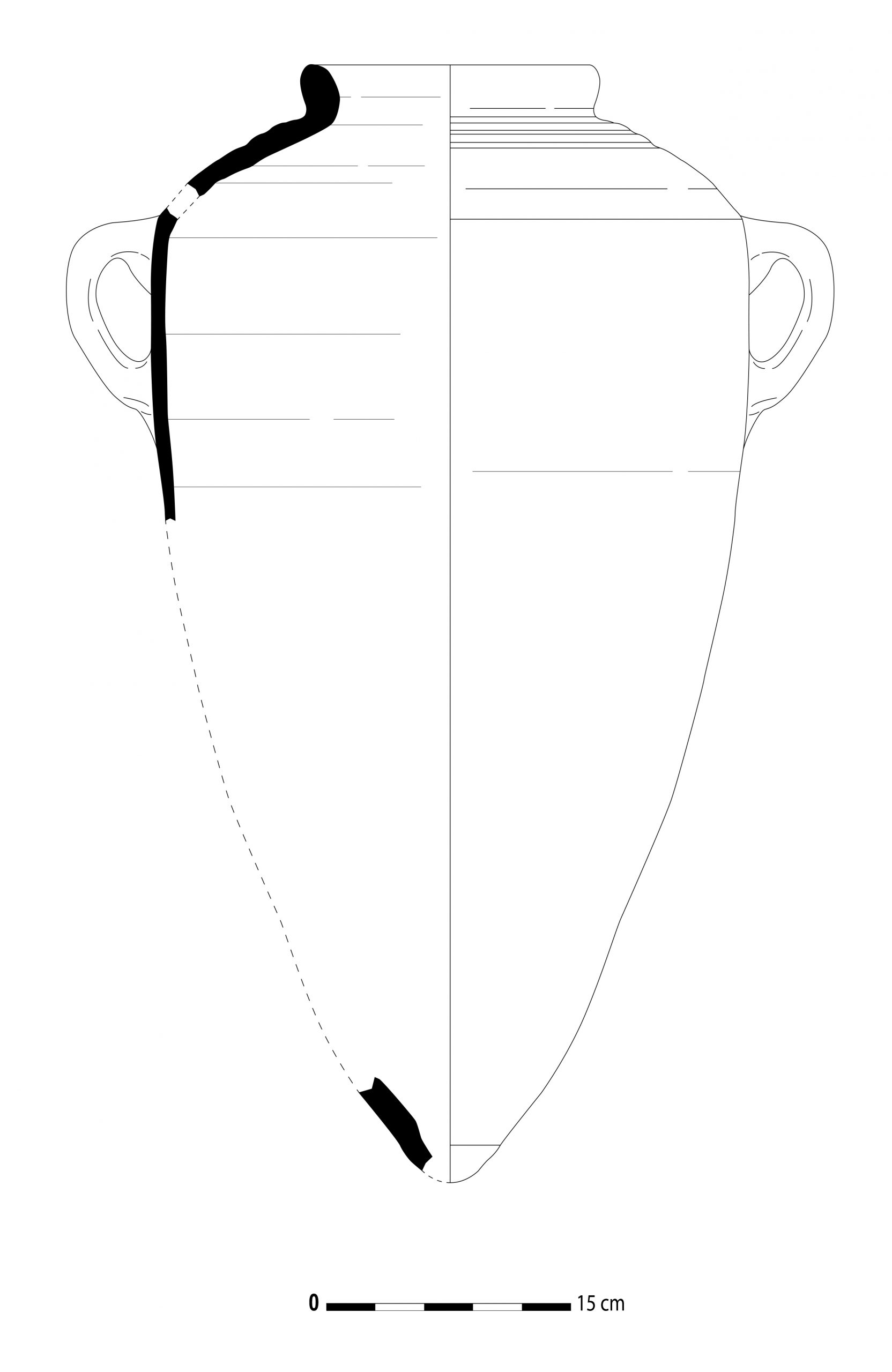
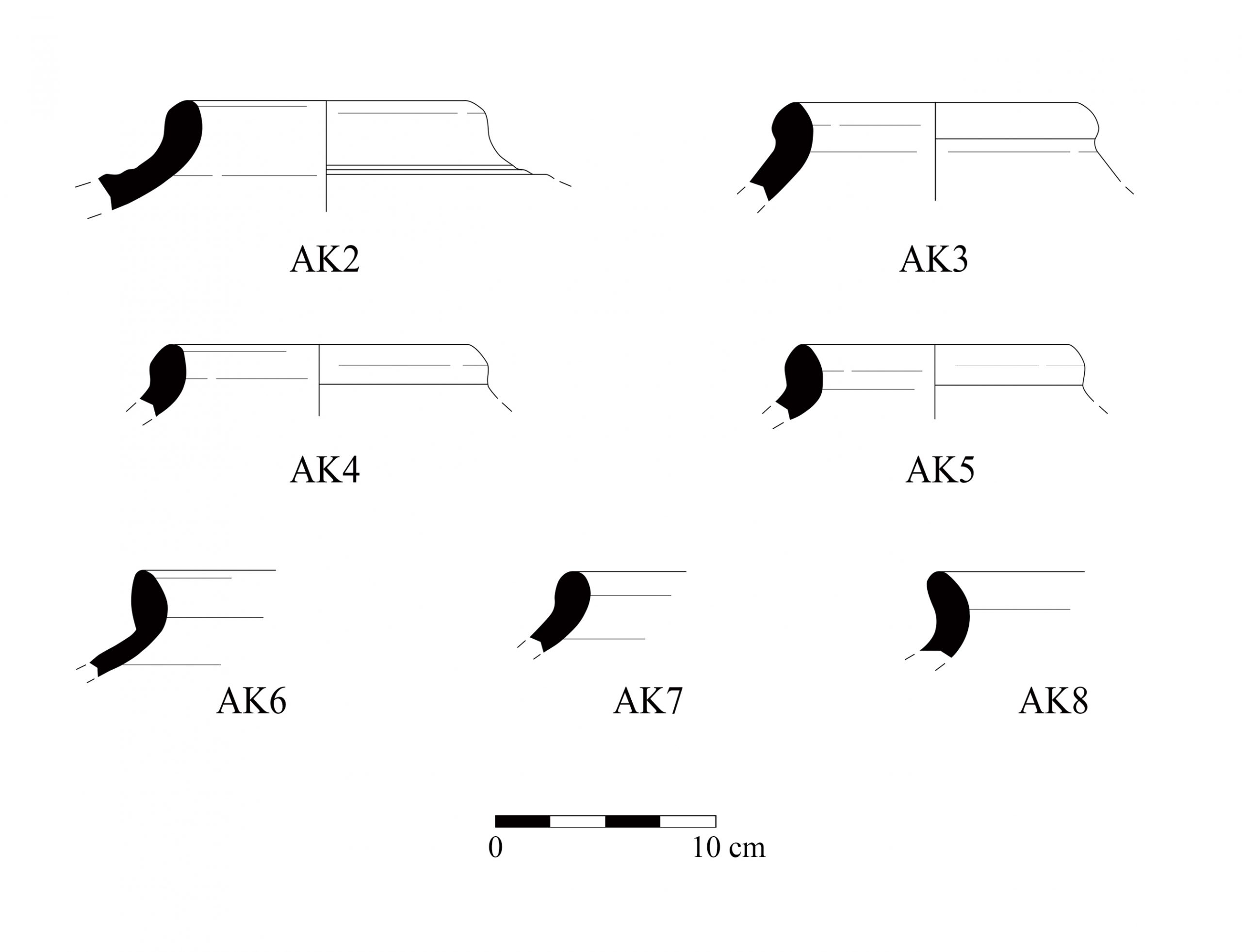
- Preservation conditions: All the Phoenician amphorae were broken and quite fragmented. In fact, only the profile of one amphora – AK1 – was mended and allows examining the typology of the vessel. For the rest of Phoenician maritime transport containers, only the rims can be studied.
- Metrics: AK1: Height = 61, 95 cm, Max. diameter = 44, 5 cm, Rim diameter = 12 cm; AK2: Conserved height = 4, 6 cm, Rim diameter = 13 cm; AK3: Conserved height = 3, 5 cm, Rim diameter = 12,5 cm; AK4: Conserved height = 3, 2 cm, Rim diameter = 13, 5 cm; AK5: Conserved height = 3 cm, Rim diameter = 12, 5 cm; AK6: Conserved height = 4, 4 cm; AK7: Conserved height = 3, 2 cm; AK8: Conserved height = 2 cm.
- Provenance/fabric description: No archaeometric studies have been carried out on the amphorae from Kommos. However, several data suggest that the set of vessels discussed here have a Phoenician provenance. First, we must mention that compared items belonging to the same cluster of containers has been extensively identified and attested along the Levantine coast. Moreover, recent petrographic and chemical analyses have been performed on Bikai type SJ9 amphorae, which confirmed they were produced in the southern coast of modern Lebanon, more precisely between ancient Sidon and Tyre. Both arguments offer relevant evidences concerning the origin of the maritime containers from Kommos.
- Item or dataset description: Most of the fragments mentioned in the course of this paper consist of rims that have common morphological characteristics: a curved rim, closed mouth, and a slight curvature next to the neck. One of the amphorae did offer other fragments that allowed a more complete reconstruction of the item (AK1), since it was possible to recover part of the body closer to the handles and part of the foot. The full reconstructed profile shows a pointed shape, confirming the use of this container for maritime trade. This same amphora, AK1, presented a preserved handle, which highlights an incision produced by the introduction of a finger in the clay paste. This feature has been documented in other examples of early Phoenician productions, as in the material uncovered in Tyre, this Phoenician metropolis being presumably one of the possible production sites for the material found at Kommos. The Aznar type 1B/Bikai type SJ9 is a well-known Phoenician maritime container, extensively produced among the Phoenician communities of the coastal Levant. This amphora type probably was one of the main types exported among the Levantine commodities of the Early Iron Age. It was manufactured throughout the Iron Age I, approximately between 1100 and 900 BC. The material from Kommos shows morphological specificities that have led to consider these items as late versions of the series, dating c. 920/880 BC. The content for Aznar type 1B/Bikai type SJ9 has not been fully confirmed, but several data point towards a connection with the Phoenician wine trade. Finally, it is worth to note that the type was broadly distributed across the Eastern Mediterranean. Several sets of this type have been identified along the Levantine coast, between Tarsus in Anatolia and Arad in modern Palestine. However, a relevant quantity of this amphora type has also been discovered in several sites both in Cyprus and Egypt. The material found at Kommos are one of the most significant evidence of the Phoenician Early Iron Age wine trade in the Aegean during the early 1st millennium BC, suggesting that Crete was not the periphery of the early Greek world but a relevant hub that connected the region with Cyprus, the Ancient Near East and Egypt. We should note that no other example has been identified in mainland Greece until now, a fact that raises many questions considering the extent of other Phoenician materials discovered in Euboea dating back to the Protogeometric period.
- Epigraphy: No epigraphy has been identified on these items. One mark, difficult to categorize, has been observed on top of one of the handles discovered at Kommos (AK1). This mark has sometimes been presented as a possible stamp, but it does not seem to be an epigraphic incision and the stamping practice was not fully developed until the Classic period. Due to the fragmentary state of the material found at Kommos, we dot no think that the mark from amphora AK1 should be interpreted as a stamp or an inscription.
- References:
- Aznar, C. (2005). Exchange Networks in the Southern Levant during the Iron Age II: A Study of Pottery Origin and Distribution (Unpublished PhD thesis).
- Harvard University. Bikai, P. M. (1978). The Pottery of Tyre. Aris and Phillips. Botto, M. (2013). The Phoenicians and the spread of wine in the central West Mediterranean. In S. Celestino Pérez & J. Blánquez Pérez (eds.), Patrimonio cultural de la vid y el vino: conferencia internacional, (pp. 103-131). Universidad Autónoma de Madrid Ediciones.
- Martin, R. (2017). Iron Age Levant: Background and History of Research. In A. Knapp and S. Demesticha (eds.). Mediterranean connections: maritime transport containers and seaborne trade in the Bronze and Early Iron Ages, pp. 102-130. New York, NY: Routledge.
- Knapp, A. B. & Demesticha, S. (2017). Maritime Transport Containers, Bulk Transport and Mediterranean Trade: Discussion. In A. Knapp and S. Demesticha (eds.). Mediterranean connections: maritime transport containers and seaborne trade in the Bronze and Early Iron Ages (pp. 148-163).
- Routledge. Kourou, N. (2008). The evidence from the Aegean. In C. Sagona (ed.), Beyond the homeland: Markers in Phoenician Chronology (pp. 205-365).
- Peeters. Stampolidis, N. C. & Kotsonas, A. (2006). Phoenicians in Crete. In S. Deger-Jalkotzy & I. Lesmos (eds.), Ancient Greece: From the Mycenaean Palaces to the Age of Homer (Edinburgh Leventis Studies 3, pp. 337-360). Edinburgh University Press.
III. ILLUSTRATIONS